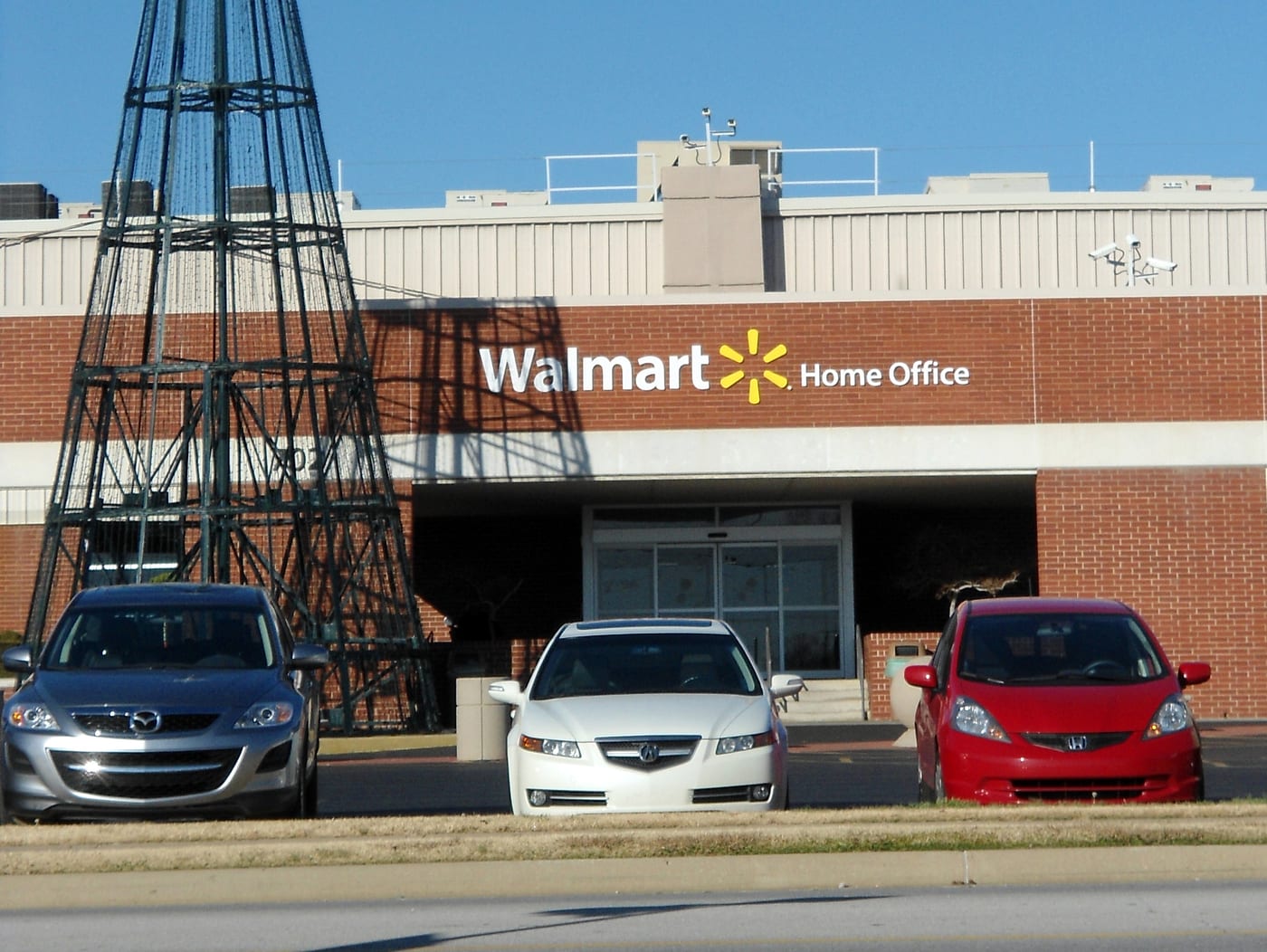
Walmart Home Office, Bentonville. CC-licensed via Wikimedia Commons.
Three siblings, each worth 145 billion dollars, the Walton public dynasty
Lede
Three siblings sit simultaneously inside the global top fifteen of the Bloomberg Billionaires Index. They are Jim Walton at approximately 148 billion dollars, Rob Walton at 145, and Alice Walton at 144. The combined fortune of the broader Walton family, per Bloomberg’s 2025 Richest Families ranking released in December, reached 513.4 billion dollars; by February 2026 a 50 billion dollar surge had taken the figure back above 513 again after a January dip to 475. The next-ranked dynasty on Bloomberg’s index, Al Nahyan, sits at 335.9 billion. Al Saud at 213.6. The Walton position is more than twice the third-ranked family in the world.
There is no precedent in modern Forbes or Bloomberg billionaires-index history for three siblings holding consecutive global top-15 rankings.
The mechanism is not exotic. It is one company, one publicly-listed ticker, one family holding vehicle, and 50.74 percent of the outstanding common stock. The Walton family is the sole senior US dynasty whose wealth is marked to market on a public exchange every trading day. Cargill is private, Mars is private, Koch is private, Wertheimer (Chanel) is private. Walmart is on the New York Stock Exchange. That single architectural choice is what makes the Walton position structurally distinct from every other family on the global senior-dynasty ranking.

Three siblings, six deployment theses
The senior generation has organised itself into six distinct deployment programmes. Each one is recognisable in the wealth press but rarely read together.
Rob Walton, the eldest son, sits at the institutional anchor. He served as Walmart’s chairman from 1992 (when Sam Walton died) until 2015, when he handed the role to Greg Penner, his son-in-law and the husband of Carrie Walton Penner. Rob co-founded Madrone Capital Partners, the Menlo Park private equity arm through which the senior Walton investment capital outside Walmart equity has flowed for decades. His most visible non-Walmart deployment was the August 2022 acquisition of the Denver Broncos for 4.65 billion dollars, the world record for a sports franchise transaction at the time. The Walton-Penner Family Ownership Group includes Carrie, Greg, Mellody Hobson, Condoleezza Rice, and Lewis Hamilton. In 2026 Sportico reported Rob quietly added a stake in the Arizona Diamondbacks.
Alice Walton, the only daughter, became the world’s richest woman in 2024 and held the title through 2025. Her deployment thesis is cultural and medical, not commercial. She founded Crystal Bridges Museum of American Art in Bentonville, opened in November 2011, on 120 acres of family-donated land in a Moshe Safdie building that is the centrepiece of a 1.5 billion dollar arts deployment per TIME’s 2025 estimate. The museum opens a 114,000 square foot Safdie expansion on 6 June 2026, a 50 percent footprint increase, alongside two landmark gift announcements made in September 2025: 18 works by women artists (Yayoi Kusama, Alice Neel, Njideka Akunyili Crosby) from chair Olivia Walton and Tom Walton, plus 200 works from Texas collectors Candace and Michael Humphreys. Her Art Bridges Foundation, launched 2017, now lends works to over 250 partner museums across all 50 states and Puerto Rico. In 2021 she announced the Alice L. Walton School of Medicine, a tuition-free nonprofit MD programme. The inaugural class of 48 students enrolled in July 2025. Reported project spending: at least 250 million dollars since 2023.
Jim Walton, the third son, is the quietest. He chairs Arvest Bank Group, the family-owned bank holding company headquartered in Bentonville; he stepped down as Arvest CEO in 2024 while retaining a 44 percent ownership stake. Arvest is the second-largest bank in Arkansas with roughly 20 billion dollars in assets across multiple states. Jim also owns Community Publishers Inc., the Bentonville-based newspaper group. Bloomberg’s February 2026 snapshot placed him at approximately 152 billion dollars, briefly the wealthiest Walton sibling.
Lukas Walton, the grandson, is the visible face of Generation 3. Born 1986, sole heir to John T. Walton’s stake after John’s June 2005 plane crash, Lukas was tracked by Bloomberg at approximately 48 billion dollars in December 2025, making him the wealthiest Walton under 40. He runs Builders Vision, the Chicago-based hybrid family office founded 2021. In a Financial Times interview published 19 June 2025, his first public media appearance, Lukas disclosed that Builders Vision had deployed roughly 15 billion dollars across the prior decade into climate, ocean conservation, regenerative agriculture, clean energy and food-system reform. Half his net worth, in other words, has been visibly converted into impact-investing capital. He stepped down as Builders Vision CEO in 2025 to chair a newly constituted board.
Christy Walton, John T. Walton’s widow and Lukas’s mother, holds the political deployment thesis. Bloomberg tracked her at approximately 22.4 billion dollars in December 2025. In March 2025 she paid for a full-page New York Times advertisement declaring “the dignity of our country is not for sale”, widely read as anti-Trump messaging; in June 2025 she ran another full-page NYT placement encouraging readers to attend the “No Kings” protests on 14 June. She funded the Lincoln Project from its 2019 founding and co-hosted a 2024 Kamala Harris fundraiser. With Lukas she co-founded iAlumbra in 2022, the grantmaking platform focused on ocean vitality, regenerative land use and community resilience, primarily in Latin America. She is one of the very few billionaire public dissidents to the second Trump term.
The Bud line, the cousins from Sam’s brother James “Bud” Walton (d. 1995), holds the trophy-sports portfolio. Ann Walton Kroenke (Forbes 2026: roughly 14.6 billion dollars) is married to Stan Kroenke, founder of Kroenke Sports & Entertainment. CNBC ranked KSE the world’s most valuable sports empire at 21.2 billion dollars in 2025. The portfolio: the Los Angeles Rams (NFL, valuation above 6 billion), the Denver Nuggets (NBA, 2023 champions), the Colorado Avalanche (NHL, 2022 Stanley Cup), Arsenal FC (Premier League, valuation 2.05 to 2.3 billion dollars), plus the Colorado Mammoth and Colorado Rapids. Nancy Walton Laurie, Bud’s other daughter (Forbes February 2026: approximately 20.8 billion), runs a less public deployment via the Laurie family office in Missouri.
Same fortune, six channels. The pattern is the architecture.

The mechanic, 50.74 percent and one share, one vote
The Walton family controls 50.74 percent of Walmart Inc.’s outstanding common stock. The disclosure is on file with the SEC.
Walton Enterprises LLC reports beneficial ownership of 3,523,409,231 Walmart shares, 44.21 percent of outstanding common stock, per the Schedule 13G/A filed January 2025. The Walton Family Holdings Trust holds an additional 520,735,838 shares, 6.53 percent. The Trust grants Walton Enterprises an irrevocable voting proxy, so the practical control is consolidated under one vehicle. Trustees of the Walton Family Holdings Trust are Alice L. Walton, Jim C. Walton, and S. Robson Walton.
The architectural choice that matters: Walmart has a single class of common stock, on a one-share-one-vote basis. There is no super-voting wedge.
This is structurally different from Meta (Zuckerberg majority voting via Class B), from Alphabet (founders’ Class B at 10 votes per share), from Berkshire Hathaway (Class A at 10,000 votes per Class B), and from Ford Motor Company (Class B family shares with super-voting). The dual-class peer set uses governance mechanics to extend founder or family voting power beyond economic stake. The Waltons do not. They simply own roughly half the equity outright. Control follows size.
The implication is what gives the Walton model its durability. A 50.74 percent stake faces no legal challenge to its voting power; super-voting structures do. Activist investors cannot manufacture a procedural attack on Walmart’s family control the way they have repeatedly contested dual-class structures at Snap, Snap Inc., Ford, Meta, and Murdoch entities. The Walton control is boring equity, which makes it more durable than the more famous founder-dynasty structures.
On 18 December 2024 the managing membership interests of Rob Walton and Jim Walton in Walton Enterprises LLC were transferred into separate irrevocable trusts. This is the most significant recent step in the post-2005 generational transition, the transition that began with John T. Walton’s plane-crash death and his stake passing to Christy and Lukas while remaining inside the Walton Enterprises vehicle. The 2024 trust restructuring suggests the family is treating Walton Enterprises as a multi-century structure, comparable to a European foundation (Wertheimer / Chanel, Ferrero) rather than an American holding company.
The buyback engine
Walmart returned over 7 billion dollars to shareholders through buybacks in fiscal 2025 alone, with 12.0 billion dollars in remaining repurchase authorization at the end of Q4 FY25. The company has raised its dividend for 52 consecutive years. The fiscal 2026 annual payout is 0.99 dollars per share, up from 0.94 in fiscal 2025, a 5.3 percent increase.
The compounding mechanic at the centre of the Walton position is the buyback engine. Continuous buybacks since the 1990s have mechanically reduced Walmart’s outstanding share count, which mechanically increases the family percentage stake even when family entities are net sellers in absolute terms. On 14 March 2025 the Walton Family Holdings Trust sold 6.2 million Walmart shares at an average 85.05 dollars per share for 527.6 million dollars in proceeds. Despite that 6.2 million share sale, the Trust retained 582.5 million shares and the family aggregate stake actually rose over the same period because Walmart’s repurchase volume exceeded the family’s net selling.
This is the single mechanic the private peer set cannot replicate. Cargill, Mars, Koch and Chanel cannot mechanically grow the family percentage through a buyback engine; their share counts are held flat by definition. The Walton model converts the public-equity architecture into a compounding feature rather than an information-control liability.
Walmart’s fiscal 2025 revenue was 681.0 billion dollars. Sam’s Club US contributed 90.2 billion of that. Early in 2026 Walmart crossed the 1 trillion dollar market capitalization threshold, the first non-tech US company to reach 1 trillion in market value.
The family-office constellation
The Walton family does not operate one family office. It operates approximately seven.
The central institutional vehicle is the Walton Family Foundation, with over 8.6 billion dollars in assets at year-end 2024 and 548.8 million dollars in 2024 grants. In 2025 the foundation announced a five-year strategic plan committing over 2 billion dollars in philanthropic support through 2030, focused on K-12 education, environment, and the Arkansas-to-Mississippi-Delta home region.
Around the foundation sit the spokes: Builders Vision (Lukas, approximately 15 billion dollars deployed over the prior decade), iAlumbra (Christy and Lukas, founded 2022, Latin American grantmaking), Art Bridges Foundation (Alice, founded 2017, museum lending network), the Crystal Bridges Museum endowment (Alice, founded 2011), the Heart of America Foundation (Alice chair), Madrone Capital Partners (Rob and Greg Penner, private equity), and the Walton-Penner Family Ownership Group (Rob and Greg, the Broncos vehicle). The Bud line operates Kroenke Sports & Entertainment as a separate satellite at 21.2 billion dollars in franchise value.
The structural feature: the Walton dynasty is functionally six family offices sharing one source asset. The Wertheimer dynasty, by contrast, is one family office (Mousse Partners) serving two principals. The Cargill dynasty, by contrast, has no disclosed central family office across its 14 family billionaires.
This pluralisation is the visible difference between the distributed public dynasty (Walton) and the concentrated private dynasty (Wertheimer). Each Walton sibling builds a distinct asset-allocation thesis that becomes a brand within the family. Rob owns sports. Alice owns culture. Jim owns banking. Lukas owns climate. Christy owns political voice. The Bud line owns the trophy-sports portfolio. The same fortune produces six recognisable deployment signatures.
What the pattern says about UHNW architecture
The third article in the leontia uhnw-convergent-patterns pillar closes a triangle.
Cargill, the first piece, established the US private distributed pattern: 14 family billionaires across roughly 20 owner-shareholders of one privately-held company, 5 generations, agribusiness, no single family office, dynasty wealth held opaque by definition.
Wertheimer, the second piece, established the European private concentrated pattern: 2 brothers, 3 generations of Chanel leadership, luxury, one central family office in New York (Mousse Partners), dynasty wealth held opaque by company-private status.
Walton, the third piece, establishes the US public distributed pattern: 7 named heirs (3 in global top 15), 3 generations, retail, six independent family-office spokes around one central vehicle (Walton Enterprises LLC), dynasty wealth marked to market on a public ticker every trading day.
The common pattern across the three is multi-generational continuity of the founding family vehicle. The common allocation pattern across the three, visible at the family-office layer, converges on the same three asset categories outside the core operating business: sports franchises (Walton-Broncos, Kroenke-multiple, Cargill-various private holdings), museums plus cultural infrastructure (Alice Walton Crystal Bridges, Wertheimer-various Chanel cultural sponsorship), direct real estate (Knight Frank’s 2025 family-office benchmark: 22.5 percent of typical allocation). The differentiation across the three is in scale, not category.
The UBS Global Family Office Report 2025 surveyed 317 family offices, average net worth 2.7 billion dollars. Only 53 percent reported having wealth-succession plans in place. Only 14 percent reported the next generation as “prepared” to manage the dynasty. The Walton family, with its post-2005 trust restructuring, its 50.74 percent equity stake, its 6-spoke family-office constellation, and Lukas’s 15 billion dollar Builders Vision platform, has visibly answered the succession question that the median family office has not.
The convergent pattern the leontia editorial mandate targets is the three-category cross-cutting deployment, not the dynasty-architecture choice. Public or private, distributed or concentrated, the senior dynasty deploys outside the core into sports, culture, and real estate. The Walton family is the largest single example of the pattern at scale.
Sources cited
- The World’s Richest Families 2025, Bloomberg
- Walmart Inc., Schedule 13G/A, SEC EDGAR, January 2025
- Walmart Inc. 2025 Annual Report
- Walton fortune: Inside the 500 billion web of family offices, CNBC, 11 December 2025
- Walmart heir Lukas Walton humane healthy planet investment bid, Fortune / Financial Times, 19 June 2025
- Walton Family Foundation 2025 Five-Year Strategic Plan
- Rob Walton’s 4.65 billion dollar Broncos purchase approved by NFL Owners, Sportico, August 2022
- Crystal Bridges Two Landmark Gifts, September 2025
- Alice L. Walton, TIME 100 Philanthropy 2025
- UBS Global Family Office Report 2025
- Knight Frank Wealth Report 2025
- Walmart heiress Christy Walton enters political discourse with NYT ad, Fortune, 25 March 2025
- CNBC most valuable sports empires 2025: Kroenke Sports tops list
Sibling articles in the convergent-patterns pillar
- The richest American family no one talks about, Cargill, the US private distributed dynasty.
- Alain and Gerard Wertheimer the two brothers who own Chanel, Wertheimer, the European private concentrated dynasty.