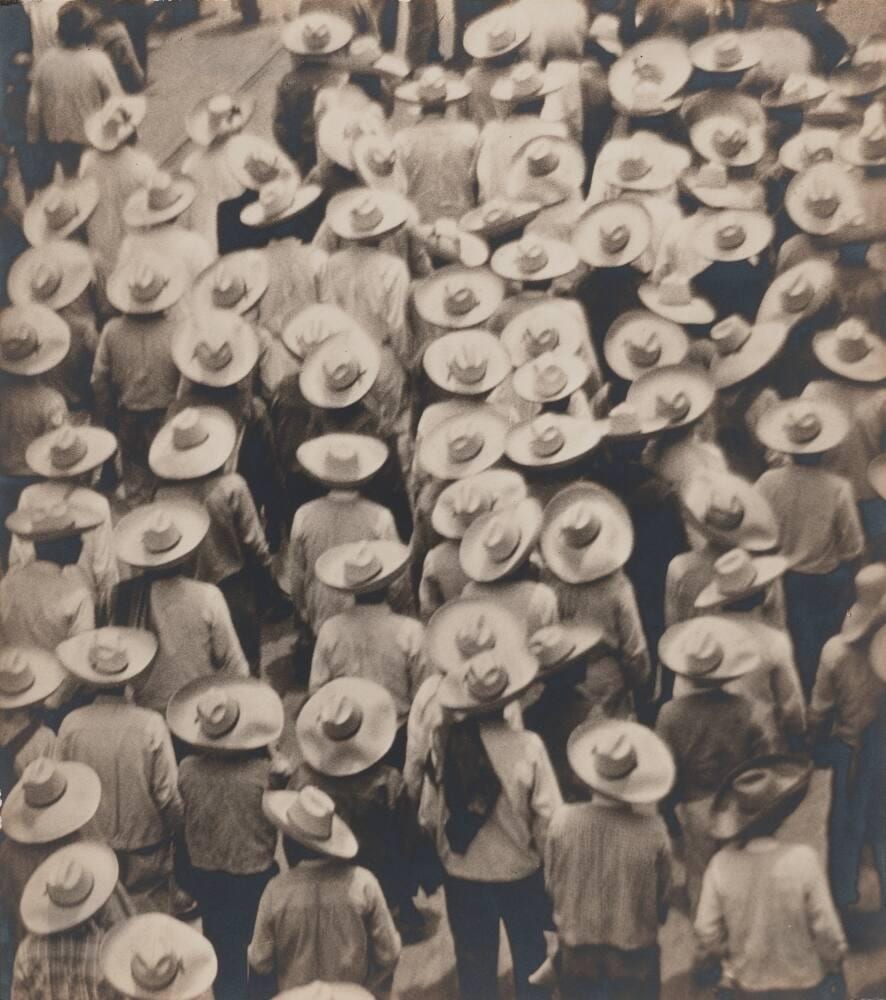
Tina Modotti (1926). Workers' Parade (Manifestación de Trabajadores). Public domain (US pre-1929; Mexico author d. 1942) via Wikimedia Commons. First published in Mexican Folkways, Aug/Sep 1926.
Photography is no longer the sleeper category
Lede
In May 2026 Phillips New York held a sold-out photography auction that totalled one hundred and fifteen point two million dollars. The number is unusual for two reasons. It is more than double the equivalent 2025 result at the same auction house. And it is the largest single photography auction result at Phillips on the public record. The catalogue was anchored by two senior single-owner consignments, the John Loeb and Tina Hills collections. The room cleared. Every lot sold. Phillips’ Head of Photographs in New York, Sarah Krueger, ran the night.
The financial press largely covered the result as a Phillips story. It is a category story. For two decades the auction-industry consensus has been that photography is the sleeper category, substantially collected by UHNW principals, structurally under-covered by the wealth press, persistently traded in the low-tens-of-millions at the marquee tier. The Phillips May 2026 result is the visible inflection point at which the consensus stops being true. The category has stepped up. The data had been telling the same story for years; the auction venue finally produced the headline.
What changed in 2025-2026
The Phillips result is one number. The wider 2025-2026 photography market produced several. The same Phillips season in 2025 set new auction records for Hannah Wilke and Roy DeCarava, two American photographers who had never been major-auction headline names. Sotheby’s, separately, restructured its photography calendar in 2025 by launching a cross-category “Prints & Photographs” sale format in New York, combining the printed and photographic mediums in a single auction slot rather than running parallel departments. The inaugural Prints & Photographs cross-category lots included Albrecht Dürer, Man Ray, Diane Arbus, Robert Mapplethorpe, and Roy Lichtenstein.
The forward calendar carries the pattern. Phillips scheduled its April 2026 photographs sale around Tina Modotti’s Bandolier, Corn, Sickle, the 1927 vintage gelatin-silver image from her Mexican period. Phillips simultaneously launched Sebastião Salgado: A Life’s Voyage as a dedicated single-artist online sale on the same calendar slot, the single-artist standalone format applied to photography. Sotheby’s April 2026 Photographs Part II auction in New York included Edward Weston, Berenice Abbott, Henri Cartier-Bresson, Diane Arbus, Robert Mapplethorpe, Graciela Iturbide, Peter Beard, and Nan Goldin. The list reads like a canonical 20th-century photography taxonomy presented as a single night’s offering.
The pattern is structural. Major-house photography sales in 2025-2026 are being curated, scheduled, and consolidated the way major-house painting sales were curated in the 2010s. The institutional treatment has caught up to the buyer base.
What didn’t change
The single-lot ceiling did not move. Man Ray’s Le Violon d’Ingres, the 1924 Surrealist photograph of model and muse Kiki de Montparnasse with f-holes painted on her back, sold at Christie’s New York on 14 May 2022 for twelve point four million dollars. Four years on, no photograph has exceeded it. The Man Ray result superseded Andreas Gursky’s Rhein II, which had held the record at four point three million from 2011. Rhein II remains the most expensive photograph by a living photographer, fifteen years stable.
The structural reading is direct. Photography is now a depth-of-market category rather than a peak-of-market one. A one-hundred-and-fifteen-million-dollar photography night is possible; a fifty-million-dollar single photograph is not. The supply that drives the aggregate is broad, Loeb, Hills, sixty-four lots cleared in a single night, but no individual photograph has yet broken into the eight-figure-ceiling territory that the painting tier reached three decades ago.
This is the category’s actual shape in 2026. The press habit of treating photography as the secondary category has been wrong about volume since 2022 and continues to be right about peak prices.

What the data has been saying
The wider HNW dataset has been carrying the same signal for several years. The Art Basel and UBS Survey of Global Collecting 2025, authored by Clare McAndrew at Arts Economics and based on three thousand one hundred HNW respondents across ten markets in the first half of 2025, put photography at twenty-one percent of HNW collectors’ stated buying plans. The ranking sat behind painting at nearly fifty percent and sculpture at thirty-seven percent, and ahead of digital art at twenty-three percent. Photography is, by HNW buyer intent, the third or fourth most-collected fine-art category globally.
The same UBS survey put HNW wealth-allocation to art at twenty percent in 2025, up from fifteen percent in 2024. That five-percentage-point shift, on a multi-trillion-dollar HNW asset base, is the demand-side capital piece that explains the Phillips number. The buyer base for fine art has materially expanded; the photography share of buyer intent has held in the twenty-percent band; the result is aggregate photography volume at a level that produces a Phillips-scale night.
The Phillips result is, in this frame, not a Phillips story. It is the visible delivery of demand-side capital that the UBS survey had already mapped.
The generational driver
The structural driver underneath the demand is generational. The Art Basel + UBS survey identified a clear pattern in fine-art category preference by collector cohort. Millennials, now in their late 20s through mid-40s, favoured prints, photography, and works on paper. Gen Z, the cohort behind them, had the highest activity rate in digital art. Gen X and Baby Boomer collectors continued to favour painting and sculpture as their primary categories.
The older end of the millennial cohort is now in its early 40s, the age at which wealth-build phases transition into serious collecting at major-auction scale. The cohort that came up through prints and photography in the 2010s, when those were the affordable and accessible entry categories, is now the buyer tier writing the cheques at Phillips. The Wilke and DeCarava records set during the 2025 Phillips calendar fit this read: the buyer tier exploring depth-of-field photographic material is operating with the curatorial granularity of a cohort that learned the category from the inside rather than the painting-tier collector switching categories.
The two-decade frame in which photography was treated as the secondary category was the frame of the Boomer and Gen X collector tier whose primary medium was painting. The 2026 frame, in which photography volume produces Phillips-scale nights, is the frame of the millennial collector whose primary medium has been photography all along.
The four sub-markets
The auction photography market splits operationally into four sub-categories. Each has its own collector base, gallery network, and price-discovery dynamic, and the Phillips $115m night drew lots from across all four.
Vintage gelatin silver is the canonical American twentieth-century: Stieglitz, Steichen, Strand, Ansel Adams, Edward Weston, Imogen Cunningham, Berenice Abbott, Tina Modotti, Walker Evans. Top tier reaches the low-to-mid seven figures; Edward Steichen prints have moved above two million. This is the category that produces the canonical headline lots at Sotheby’s and Phillips spring auctions.
Post-war fine art is the 1950-1990 generation: Richard Avedon, Irving Penn, Robert Mapplethorpe, Diane Arbus, Helmut Newton, Nan Goldin, Peter Beard, Roy DeCarava. Top tier reaches a similar band; senior Avedon prints have moved around two to three million dollars. This is the category where Phillips’ April 2026 Modotti / Salgado pairing operates.
Conceptual and contemporary is the post-1970 tier centred on the Düsseldorf School. Andreas Gursky and his Becher-trained peers, Thomas Struth, Candida Höfer, Thomas Ruff, Axel Hütte, Andreas Mühe, operate alongside Cindy Sherman, Richard Prince, Jeff Wall, Hiroshi Sugimoto. The category’s ceiling is Gursky’s Rhein II at four point three million. This is where the contemporary buyer tier is most active.
Press and documentary is the Magnum tradition and its successors: Henri Cartier-Bresson, Robert Capa, Sebastião Salgado, Susan Meiselas, James Nachtwey, Graciela Iturbide. Top tier reaches the low-to-mid six figures for most photographers; Cartier-Bresson vintage prints have reached the low seven figures. Phillips’ April 2026 Salgado: A Life’s Voyage online sale is the format-experiment for this sub-market.
The four-sub-market shape matters for the wealth-press reader because it explains how the aggregate volume can be at major-auction scale while no individual photograph crosses the Man Ray ceiling. The volume aggregates across categories the buyers treat as substantially separate; the peak prices are individual prints whose category ceilings sit independently.
The senior galleries
The primary market for top-tier photography in 2025-2026 sits with a small group of specialised galleries that have operated for decades. The four-gallery backbone explains the secondary-market supply at the auction houses the way Hauser & Wirth and Gagosian explain the painting side.
Pace absorbed its photography department into the main gallery after the death of Peter MacGill in 2020, MacGill had founded Pace/MacGill Gallery as a partnership with Arne Glimcher’s Pace in 1983. The Pace photography roster historically included Robert Frank, Irving Penn, Richard Avedon, Robert Mapplethorpe, and Joel Meyerowitz.
Howard Greenberg Gallery in New York, founded by Howard Greenberg in 1981, has specialised in twentieth-century vintage gelatin silver photography for four decades. It is the primary-market venue for Henri Cartier-Bresson’s estate material and a senior consignment source for major-house photography sales, the gallery whose name shows up in auction-house lot provenance more often than any of its peers.
Fraenkel Gallery in San Francisco, founded by Jeffrey Fraenkel in 1979, anchors the West Coast primary market. Its roster includes Diane Arbus, Lee Friedlander, Hiroshi Sugimoto, Garry Winogrand, Adam Fuss, and Mark Ruwedel.
Hamiltons in London, founded by Tim Jefferies in 1977, anchors the European primary market. It specialises in fashion and contemporary photography, the Helmut Newton estate, Bert Stern, Norman Parkinson, Don McCullin, Erwin Olaf, alongside secondary-market positions in Irving Penn and Andreas Gursky.
The four-gallery backbone produces the supply that the Phillips, Sotheby’s, and Christie’s secondary-market sales trade. Naming the galleries provides operational granularity that the major art-market coverage rarely supplies.
Reading the step-up
The Phillips one-hundred-and-fifteen-million-dollar night is the visible delivery of a structural pattern that the underlying data had been signalling for several years. Photography sits at twenty-one percent of HNW buyer intent; the millennial cohort that favours the category is now in the wealth-build phase; the four sub-markets and the senior galleries between them produce enough curatorial depth to support a sold-out major-auction night; the single-lot ceiling stays where it has been since 2022.
The wider 2025 picture pairs with this. The leontia analysis of the Abu Dhabi-Sotheby’s deal traced how the receiving capital base for major-house art deepened structurally during 2024-2025, ADQ’s billion-dollar minority stake in Sotheby’s, the inaugural Sotheby’s Abu Dhabi Collectors’ Week, the HNW art allocation rising from fifteen percent to twenty percent. The same dataset that produced the Lauder Collection’s five-hundred-and-twenty-seven-million-dollar night at Sotheby’s in November 2025 produced the Phillips photography night six months later. The category names differ. The receiving-side capital is the same capital.
For the wealth-press reader, the lesson is structural. Photography has caught up with painting and sculpture at the aggregate-volume level. The single-lot ceiling has not moved and may not for several more years. The category is now a depth-of-market story rather than a peak-of-market one. The press habit of treating photography as a secondary category has been wrong about volume for at least three years. The 2026 Phillips result is the moment the wrong reading became uncomfortable to maintain.

What to watch
Three developments will define the photography market over the next twelve months. The first is whether the spring 2027 Phillips photography night clears, even approximately, the May 2026 one-hundred-and-fifteen-million-dollar mark. If it lands at or above, photography volume at major-auction scale is the new baseline. If it lands well below, the May 2026 result becomes the cycle-peak rather than the floor.
The second is the single-lot ceiling. Man Ray’s twelve point four million has stood since 2022. The first single photograph to break that ceiling will be a structural signal, a peak-of-market step-up rather than only the depth-of-market step-up the 2025-2026 results have already delivered. Speculation in trade circles centres on a Stieglitz vintage print from the senior American collection tier or a Mapplethorpe at a record-clearing single-owner consignment, but the timing is unknowable.
The third is the Sotheby’s cross-category Prints & Photographs format. The 2025 launch consolidated two departments into one calendar slot. If the format produces materially higher per-lot results than the parallel-department predecessor delivered, the Christie’s photography department will face structural pressure to consolidate similarly. The auction-house calendar reshape would be the second-order consequence of the buyer-base shift.
For the reader who tracks fine-art category share as a question of where capital actually sits, the position is now clear. Photography is the third-ranked category by HNW buyer intent. The millennial cohort drives the demand. The Phillips one-hundred-and-fifteen-million-dollar night is the visible delivery of capital that the data had already shown was building. The sleeper category caught up.
Sources cited
- The Art Newspaper on the Phillips New York May 2026 $115.2m sold-out photography auction. See 2026-05 Phillips New York 115.2m photography sold out John Loeb Tina Hills.
- Christie’s, PopPhoto, and The Value on the Man Ray Le Violon d’Ingres $12.4m record at Christie’s New York 14 May 2022. See 2022-05 Man Ray Le Violon d Ingres 12.4m record Christies.
- Phillips department coverage on the 2025 Hannah Wilke and Roy DeCarava auction records. See 2025 Phillips Photographs sales calendar Hannah Wilke DeCarava records.
- Sotheby’s department on the 2025 launch of cross-category Prints & Photographs and the April 2026 schedule. See 2025 Sotheby Prints Photographs cross category launch April 2026 schedule.
- Phillips press on the April 2026 Tina Modotti and Sebastião Salgado: A Life’s Voyage dedicated sales. See 2026-04 Phillips Tina Modotti Bandolier Sebastiao Salgado Life Voyage dedicated sale.
- Art Basel + UBS Survey of Global Collecting 2025 on the 21% photography share of HNW buying plans and the 20% HNW art allocation. See 2025 Art Basel UBS HNW photography 21pc buying plans 20pc art allocation.
- Maddox Gallery / Art Basel on the millennial preference for prints, photography, and works on paper. See 2025 millennial collectors prints photography works on paper generational driver.
- Artnet and Wikipedia on the contemporary-tier living-photographer ceiling and the Düsseldorf School. See 2025 Top photographers at auction Gursky Prince Sherman Wall living tier.
- leontia synthesis on the four photography sub-markets (vintage / post-war / contemporary / documentary). See Four photography sub-markets vintage post-war contemporary documentary.
- leontia synthesis on the senior photography galleries (Pace, Howard Greenberg, Fraenkel, Hamiltons). See Senior photography galleries Pace Howard Greenberg Fraenkel Hamiltons.