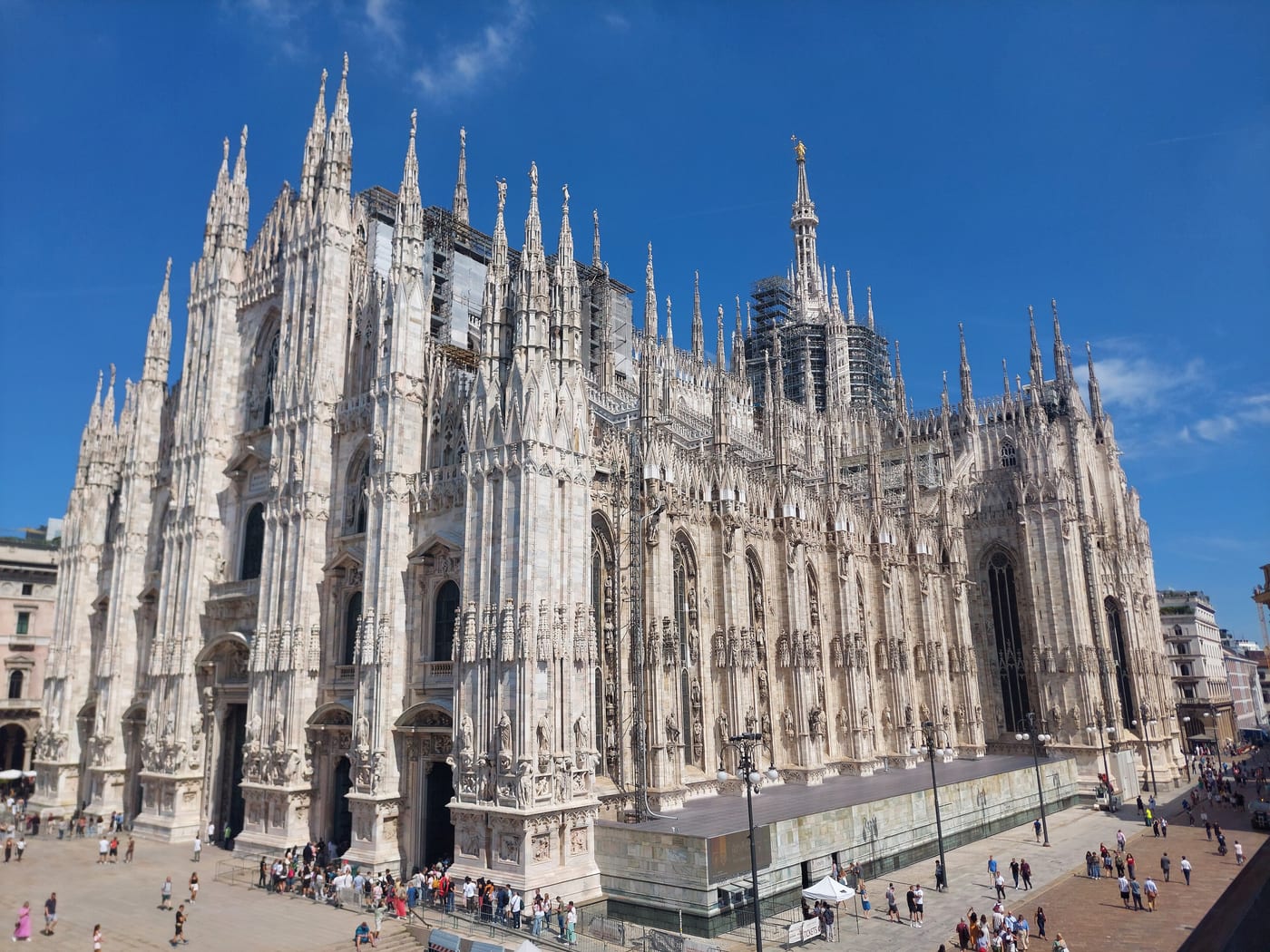
Exprimidor (4 September 2025). Milan Cathedral (Duomo di Milano). CC BY-SA 4.0 via Wikimedia Commons.
Italy just priced the non-dom market at €300,000
Lede
On 1 January 2026 the Italian flat-tax regime for non-doms became more expensive. The annual headline charge, paid in lieu of full Italian taxation on foreign income and gains, rose from €200,000 to €300,000. The supplement for each qualifying family member doubled from €25,000 to €50,000. The regime remains otherwise intact, fifteen years, no remittance restriction, full foreign-income exemption, and the 2025-vintage entrants are grandfathered at the lower €200,000 rate for the full duration of their windows. For new arrivals from 2026 onward, the cost of an Italian landing has gone up by half.
This is the second hike in eighteen months. Italy doubled the flat tax from €100,000 to €200,000 in August 2024; the move to €300,000 was approved in late 2025 and entered force at the start of this year. The receiving end of the UK non-dom wave is now exercising pricing discipline. The wider receiving competition is reading the line.
What changed in Italy
The mechanics are mechanical. The Italian non-dom regime, in place since 2017, allows a new tax resident to elect a fixed annual charge in lieu of standard Italian taxation on foreign income and capital gains. Italian-source income is taxed normally. The election runs for up to fifteen years; the charge is settled per individual, with a per-family-member supplement; the regime does not require a remittance trigger.
The headline rate has now moved twice. The original 2017 setting was €100,000 per year plus €25,000 per family member. The August 2024 budget law doubled the principal rate to €200,000 (the family supplement was left at €25,000). The 2026 budget law, signed off in October 2025 and effective from 1 January 2026, raised the principal to €300,000 and the family supplement to €50,000. The duration of the regime, the foreign-income exemption, and the absence of a remittance basis remain unchanged.
The grandfathering is the structural detail. Anyone who elected the regime from the 2025 tax year continues to pay €200,000 for the remainder of their fifteen-year window, meaning a 2025-vintage cohort now holds a structural pricing advantage that will last into 2040. The November-December 2025 application rush that Italian tax advisors openly described to the financial press was, in this light, fully rational. The cost of locking in the lower rate was a one-time decision with a fifteen-year payoff.
Even at €300,000 the Italian regime remains structurally competitive. Switzerland’s federal minimum taxable base for the lump-sum forfait fiscal sits at CHF 435,000 from 2026; Zug demands an effective annual charge close to CHF 1 million. The UK’s post-non-dom FIG regime gives four tax-free years on foreign income and gains, then full worldwide taxation, meaningfully shorter than Italy’s fifteen. The Greek €100,000 regime is the only meaningfully cheaper headline number in Europe. The Italian discipline event is real, but Italy has not priced itself out of the market.

What’s flowing in
The Italian inflow numbers are smaller than the press estimates implied. Nearly 1,500 individuals took the regime in 2023, on data published in 2024 by the Italian Court of Auditors. Henley & Partners projected approximately 2,200 USD-millionaire-tier arrivals into Italy for 2024. Both numbers are low single-thousands per year, a meaningful flow, but well below the tens-of-thousands receiving-volume that some advisor-side estimates had floated.
Milan is the residential anchor. The Italian financial capital has been the single largest beneficiary of the inflow; the press coverage during 2024-2025 explicitly named the housing-market spike and the cost-of-living squeeze in central Milan as direct consequences. Florence, Rome and the Como tier received secondary flows. The Italian regime is not absorbing the wave into a new tier of Tuscan villages, it is concentrating into Milan first, with the European receiving competition following the financial city rather than the heritage one.
Greece: the only cheaper European seat
Greece introduced its non-dom regime in 2019 at €100,000 per year for fifteen years, with a €20,000 supplement per family member. After the January 2026 hike in Italy, Greece is now the only European non-dom regime priced at a third of Italy’s headline cost. The Greek property entry is also the cheapest of the European trophy markets, addressed at length in the leontia Athens piece. George Procopiou’s €150m repurchase of the final third of the Astir Palace Vouliagmeni in October 2024 is the cleanest single signal that the Greek-diaspora capital understands the structural advantage. Foreign-buyer share in Athens hit roughly forty percent of residential transactions in Q2 2025.
The Greek regime is the cost-driven choice. The senior UHNW principal who wants the European base, currency, language, EU passport, sub-three-hour flight to London or Paris, without the Italian €300,000 ticket now has one obvious option.

Switzerland: the senior-principal regime
The Swiss forfait fiscal, in place since 1934 in something like its current form, runs differently. The tax is determined as the higher of (a) the federal minimum taxable base of CHF 435,000 for 2026, (b) seven times the annual rent or rental value of the principal residence, or (c) three times the annual cost of full hotel board. The applicant must not engage in any gainful employment in Switzerland and must spend approximately 183 days per year in the country.
The 2025 data confirmed the Swiss receiving share. Switzerland’s State Secretariat for Migration reported 496 non-EU nationals holding lump-sum residence permits as of March 2025, a 22% increase year-on-year. British nationals accounted for 10% of applicants, the single largest non-EU national group. The canton split among all lump-sum residents: Geneva 25%, Valais 12%, Ticino 11%, Vaud 9%.
The no-employment rule is the structural friction. For the post-exit principal, sold the business, transitioned to investment-vehicle income, no operational headquarters need, the Swiss forfait is the regime of choice. The lifetime duration, the substance-based tax, and the cantonal flexibility all align. For the active founder or operator, the rule is a hard limit. Switzerland’s receiving share is concentrated, accordingly, in the post-exit cohort. The Italian €300,000 regime, by contrast, allows active in-country work.
Dubai: the zero-rate regime and the family-office home
The UAE flow is different again. Dubai does not run a flat tax; it runs no personal income tax, no capital gains tax, and no dividend tax at the individual level. The 9% corporate income tax introduced in 2023 sits above the family-office holding structure for personal investment income. Family principals typically obtain residency through the Golden Visa (ten-year renewable) and a Tax Residency Certificate, which requires 183 days of physical UAE presence per year.
The 2025 data on the receiving competition at the senior family-office tier is the cleanest comparative dataset published this year. More than 200 new family offices were established in Dubai in 2025, more than twenty percent of global new family-office setups for the year, bringing the total to over 800 and giving Dubai roughly ten percent of the world’s family offices. The DIFC threshold for a single-family-office licence is approximately US$50 million in aggregate net assets, with no hard requirement for a non-family investment professional. The UAE-wide single-family-office average AUM is close to US$900 million, meaningfully above the equivalent Singapore figure, which sits at a lower average per office across a Section 13O / 13U regime with similar nominal AUM thresholds.
Dubai is the receiving regime that competes on a fundamentally different basis. The Italian €300,000 is a high headline charge for a flat regime; the UAE 0% is a low headline charge for a residence-based regime. The 183-day requirement is the structural friction. For a London family principal who runs a business in London and prefers Mayfair for half the year, Dubai is not viable. For a post-exit principal with no operational UK tie and a willingness to spend most of the year east of Suez, Dubai is the most tax-efficient option of the receiving set. The English common-law overlay in DIFC and ADGM is what makes the choice institutionally comfortable for the UK departure cohort specifically.

Spain and Portugal: the divergent Iberian tier
The Iberian receiving regimes have moved in opposite directions during 2024-2026. Portugal’s Non-Habitual Resident (NHR) regime formally ended on 1 January 2025; the replacement, marketed as IFICI or “NHR 2.0”, retains the surface arithmetic (20% flat rate on qualifying Portuguese-source income, ten years, foreign income broadly exempt) but narrows eligibility sharply to scientific research and innovation activity. The pre-2025 use case, Northern European retirees pension-routing through Portugal, is now closed. Existing NHR registrants are grandfathered for their full ten-year period.
Spain’s Beckham Law, by contrast, broadened. The flat 24% rate on Spanish-source earnings up to €600,000 per year remains; the prior-non-residence requirement was permanently cut from ten years to five; holders of the International Telework Visa now qualify. The Beckham regime runs for six years (year of arrival plus five subsequent). The structural shift is that Spain is now competitive for the post-exit founder who wants an active European base and is willing to anchor in Madrid or Barcelona, while Portugal has narrowed to the academic/researcher tier.
The Iberian receiving picture is the example of regime divergence rather than regime convergence. The 2020-2024 frame (“Lisbon as the cheap-retiree alternative; Madrid as the active-base option”) no longer describes either jurisdiction accurately.

What the UK exit data actually says
The British-side numbers are the second half of the picture. HMRC’s early payroll and administrative data for 2025-26, reviewed by the Treasury and the OBR through the spring, indicate that roughly 25% of non-doms with trusts and roughly 10% of non-doms without trusts have departed. The split itself carries the editorial signal: the highest-net-worth cohort (the trust-using senior tier) is departing at a materially higher rate than the broader non-dom population. The split is also close to what the OBR modelled at the time of the reform.
Henley & Partners and Wealth-X estimate that approximately 10,800 USD-millionaires left the UK in 2024 and project a further 16,500 across 2025-2026, representing roughly $91.8 billion in liquid wealth in motion. The 16,500 figure is the headline number that the press has carried; the HMRC 25%/10% trust split is the cleaner version. The Treasury’s pre-reform position was, in essence, the same: the departure was real, was disciplined, and would not be the order-of-magnitude exodus that the right-wing press carried through 2024.
The Temporary Repatriation Facility (TRF) is the structural counterweight. From 6 April 2025 to 5 April 2028, individuals who previously claimed the remittance basis can designate and remit historical foreign income and gains at 12% (for 2025-26 and 2026-27) or 15% (for 2027-28). The TRF is the explicit Treasury concession to stay, the carrot alongside the FIG-abolition stick, and a meaningful share of the non-dom population is doing the calculus and remaining UK-resident under the new regime. The next full HMRC publication with post-reform data lands in late 2026.
Reading the Italy hike
The Italian regime move from €200,000 to €300,000 in eighteen months is the most visible single signal that the receiving end of the non-dom wave has matured. The 2017-2024 frame, receiving regimes competing to attract, has shifted. From 2026 the receiving regimes are competing on a sorted basis, with each regime now visibly priced against an archetype rather than against each other.
The taxonomy is now clean enough to write down:
- Senior UHNW principal, post-exit: Switzerland (lifetime regime; no-employment rule; substance-based tax). The €435,000 federal minimum and €1m Zug effective rate sit comfortably for the principal whose income runs in nine-figure annual investment yield.
- Active founder or operator wanting a European base: Italy (still, despite the hike) or Spain (Beckham). Both are compatible with active in-country work; Italy gives fifteen years and full foreign-income exemption; Spain gives six years and a low Spanish-source rate.
- Zero-tax-tolerant, willing to spend most of the year east of Suez: Dubai. The DIFC family-office infrastructure is the institutional unlock.
- Cost-driven mid-tier European: Greece. The cheapest European headline rate, the cheapest European trophy-property tier, EU passport.
- Researcher or innovator with academic-track substance: Portugal IFICI.
Each archetype now maps to a discrete regime. The pre-2024 reading of “all the receiving regimes are basically interchangeable” is no longer accurate. The Italian €300,000 line is the index that made the taxonomy legible.

What to watch
Three developments will define the receiving market over the next twelve months. The first is whether any other receiving regime hikes in response. Italy’s discipline event is open evidence that pricing pressure can be exerted on the inflow without losing it; Greece, Spain, Switzerland and the UAE are all watching the Italian application volume through 2026 for the demand-elasticity signal. The Greek €100,000 regime is the most plausibly hike-able, a step to €200,000 would still leave Greece structurally competitive against Italy. The Swiss federal minimum is more politically constrained.
The second is the late-2026 HMRC publication. The current 25%/10% trust split is early-payroll-data work; the formal HMRC dataset arriving toward the end of this year will be the first authoritative measure of post-April-2025 departure behaviour. If the trust-cohort departure rate edges up toward 30-35%, the Treasury revenue assumptions on which the reform was scored will need revisiting. If it stays close to 25%, the OBR modelling will be vindicated and the policy debate will move on.
The third is the 2025-grandfathered Italian cohort. Anyone who elected Italy in the 2025 window now holds a fifteen-year structural advantage over any 2026-onwards entrant. The advisory practices that organised the November-December 2025 application rush will be measured on whether that vintage of clients quietly compounds inside the €200,000 envelope or whether some friction, Italian compliance tightening, residency-substance audit, or a future repeal of grandfathering, disturbs the assumption that the lower rate is locked.
For the reader who tracks tax-residency flow as a category, the lesson is structural. The 2017-2024 decade was the decade in which the receiving regimes competed to be cheap; the 2025-2026 transition is the decade in which the receiving regimes compete to be matched. Italy drew the €300,000 line. The rest of the receiving competition is reading it.
Sources cited
- IMI Daily and the Italian Budget Law 2026 on the Italian flat-tax rise from €200,000 to €300,000. See 2026-01 Italy flat tax raised 200k to 300k.
- Italian Court of Auditors and Henley & Partners on the 2023-2024 Italian flat-tax inflow figures. See 2023 Italy 1500 uptake Henley 2200 movers 2024 forecast.
- Katten Muchin Rosenman aggregation of HMRC and OBR data on early 2025-26 non-dom departure rates. See 2026 HMRC early FIG TRF departure data 25pc 10pc.
- Henley & Partners / Wealth-X Private Wealth Migration Report on UK millionaire departures. See 2024-2025 Henley UK millionaire departure 10800 plus 16500.
- Saffery and Norton Rose Fulbright on the UK Temporary Repatriation Facility mechanics. See 2025-2028 TRF mechanics 12 15 percent preferential rates.
- Tax Trends and Norton Rose Fulbright on the UK FIG regime mechanics. See 2025 UK FIG regime mechanics 4 years foreign income tax free.
- Switzerland State Secretariat for Migration and TaxRavens on the 496 non-EU lump-sum permits and 22% increase. See 2025-03 Switzerland forfait 496 non-EU permits 22pc rise 10pc British.
- Key Advisory and DIFC reporting on the Dubai 2025 family-office formation data. See 2025 Dubai 200 new family offices 800 total 10pc world share.
- ImmigrantInvest and Pellicer & Heredia on the Portugal IFICI and Spain Beckham regime changes. See 2025 Portugal IFICI Spain Beckham Iberian receiving tier.
- ASEAN Briefing and IQ-EQ on the Singapore Section 13O/13U thresholds and Dubai comparison. See 2025 Singapore 13O 13U Dubai DIFC family office AUM comparison.
- Astons and Armenian Lawyer on the UK non-dom abolition driving Greek demand. See 2025-04 UK non-dom abolition drives Greek demand.