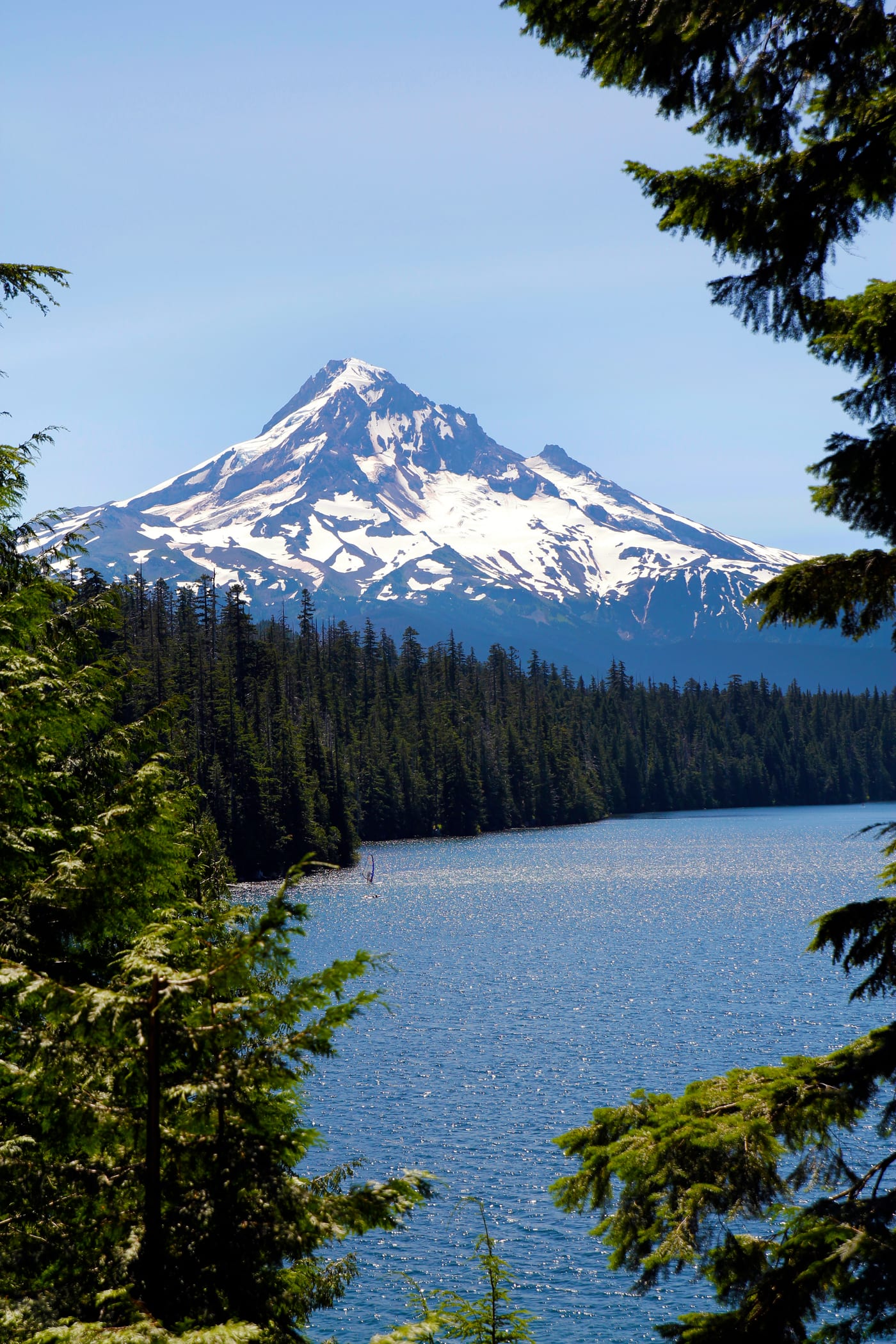
Mt Hood and Lost Lake, Oregon. CC-licensed via Wikimedia Commons.
The 95,000 dollar psilocybin client
Lede
The first full operational year of Oregon’s state-level legal psilocybin services produced approximately eight thousand clients across thirty-one licensed service centers. By the first quarter of 2025, the number of operational centers had fallen to twenty-five. Nine centers closed in roughly eighteen months. Of the clients who disclosed their income to the Oregon Health Authority, the majority earned more than ninety-five thousand dollars per year. Of those who shared their age, the majority were over forty-five years old. Per-session pricing typically ran one and a half to three and a half thousand dollars and was not covered by insurance. Colorado opened licensing under its parallel Natural Medicine Health Act on the last day of 2024. Through 2025 the second state-level psychedelic-services framework came online.
The 2020 to 2022 Oregon ballot-initiative rhetoric had positioned state-level psilocybin services as a mass-market mental-health intervention. The 2024 to 2025 operational data shows that, in practice, the programme is a UHNW-adjacent service. The leontia analyses of the April 2026 executive order and the Apeiron and AtaiBeckley biotech-equity capital flow cover the regulatory and biotech sides of the renaissance. This article covers the operational state-level layer and what its economics actually look like.
What Oregon does and what Oregon costs
Oregon Measure 109, passed in November 2020 and operational from January 2023, created the first state-level legal psilocybin programme in modern history. The framework is therapeutic-supervision only. Adults age twenty-one and over may access psilocybin services at licensed service centers under the supervision of licensed facilitators. There is no personal-use right, no home cultivation, no community-use provision. The substance must be sourced from licensed cultivators, tested at licensed testing centers, and administered at licensed service centers by licensed facilitators.
The Oregon Health Authority licenses four categories of operators. Service centers pay a ten thousand dollar annual licence fee. Facilitators pay roughly two thousand dollars to complete training and license. Manufacturers (cultivators) and laboratories pay separate fees. The service centers must operate under mandated security infrastructure including alarm systems, video monitoring, and restricted-access storage protocols. Insurance, capital improvements, and staffing add additional cost. The total all-in cost for a service center to operate, before client revenue, runs in the high tens of thousands to low hundreds of thousands of dollars per year depending on facility size and location.
The client-facing economics work against scale. A single psilocybin session typically runs six to eight hours, including preparation and post-administration integration. A facilitator can supervise a small number of clients per session, with the typical ratio running one facilitator to one or two clients. Per-session pricing of fifteen hundred to thirty-five hundred dollars reflects the staffing and time cost. Insurance does not cover the service, and out-of-network reimbursement is not generally available. The price point sits between high-end concierge psychiatry and boutique wellness-clinic services.
The Oregon Health Authority’s 2025 operational data tells the demographic story underneath the economics. Of the roughly eight thousand 2024 clients, the majority who disclosed income earned more than ninety-five thousand dollars per year. The majority who disclosed age were over forty-five years old. Geographic clustering of the licensed centers along Interstate 5 reflects both regulatory permit-friendliness in specific counties and proximity to the upper-middle-income Portland-to-Eugene urban corridor. The client demographic that the operational data describes is the upper-middle-income to UHNW-adjacent professional cohort, not the mass-market mental-health population that the 2020 to 2022 ballot rhetoric had implied.
The nine service-center closures in eighteen months are the operational signal. Even at UHNW-adjacent pricing, the unit economics are stressed. The centers that closed cited high operational costs, regulatory compliance burden, and slower-than-projected client volume. The centers that remained operating into mid-2026 are concentrated in the Portland, Eugene, and Bend metropolitan markets and are typically operated by founders with adjacent wellness-services or therapy experience rather than first-time operators.

What Colorado does differently
Colorado Proposition 122, passed in November 2022 and codified as SB23-290, created the second state-level psychedelic framework in the US. The Colorado Department of Regulatory Agencies opened licensing on the last day of 2024 for three license categories: therapy, cultivation, and testing. Through 2025, healing centers came online across the state.
Colorado’s framework differs from Oregon’s in one structurally important respect. Adults age twenty-one and over may grow, possess, and share natural psychedelic substances on their own property. Personal cultivation is legal. Communal use, defined as sharing without commercial exchange, is also legal. Colorado is the first US state to grant a personal-use right at this level. The therapeutic-supervised framework that runs alongside the personal-use right operates similarly to Oregon’s, with licensed facilitators administering supervised sessions at licensed healing centers.
The two-track structure changes the demographic equation. A Colorado resident who grows their own psilocybin mushrooms and uses them at home faces no licensing or licence-fee cost. The economic floor is sub-hundred-dollars. A Colorado resident who accesses a licensed healing center for supervised therapy pays comparable per-session pricing to Oregon. The framework supports both pathways and serves different demographics through each.
The Natural Medicine Advisory Board has authority to extend the programme by June 2026 to include dimethyltryptamine (DMT), ibogaine, and mescaline. The Trump executive order’s 50 million dollar federal commitment to ibogaine research aligns the Colorado expansion timing with the federal funding cycle. If Colorado approves ibogaine for the state-level framework by June 2026, the state becomes the first US state with operationally legal therapeutic ibogaine, anchored to federal research funding.
For the leontia reader, the Colorado framework is the structural alternative to the Oregon model. Oregon is the therapeutic-only, higher-cost, UHNW-adjacent supervised-service model. Colorado is the dual-track model that adds personal-use rights to the same supervised-service framework. The comparative operational data over 2026 to 2027 will determine which model the next state-level frameworks (California, Washington, Massachusetts have all been at various stages of legislative consideration) take as the template.
The international retreat circuit operates in parallel
Outside the US state-level frameworks, the international ayahuasca and psilocybin retreat circuit has operated since the 2010s at comparable per-session economics. Soltara Healing Center in Costa Rica, founded 2017, runs seven to nine day Shipibo-tradition ayahuasca retreats at approximately thirty-five hundred to sixty-five hundred dollars per retreat depending on accommodation tier. Rythmia Life Advancement Center, also in Costa Rica and founded 2015, runs seven-day all-inclusive ayahuasca programmes at fifty-five hundred to ninety-five hundred dollars and has hosted approximately twenty thousand plus participants since founding. Temple of the Way of Light in Peru, founded 2007 in Iquitos, runs twelve-day Shipibo-tradition retreats at thirty-five hundred to forty-five hundred dollars. Spirit Vine in Brazil operates Santo Daime and União do Vegetal influenced retreats at two thousand to four thousand dollars.
The international circuit predates the US state-level frameworks and continues to operate alongside them. The per-session economics are comparable. A multi-session Oregon client paying fifteen hundred to thirty-five hundred dollars per session would spend roughly the same on a one-week Soltara or Rythmia retreat covering three to six ayahuasca ceremonies. The international circuit adds an international travel component but removes the multi-session scheduling overhead. For a UHNW client deciding between an Oregon session, a Colorado session, and a Soltara retreat, the financial comparison is approximately neutral; the differentiation is on substance preference (psilocybin in Oregon and Colorado, ayahuasca at the international retreats), framework preference (clinical-licensed in the US, indigenous-tradition-licensed in Costa Rica and Peru), and travel preference.
The international circuit serves the same client demographic that the Oregon and Colorado operational data describes. The Soltara, Rythmia, and Temple of the Way of Light client population is documented as upper-middle-income to UHNW, age thirty-five to sixty-five, with substantial overlap with the Silicon Valley tech-founder cohort and the New York finance-executive cohort. Publicly identified participants include Tim Ferriss as an advocate and participant, Joe Rogan as a documented participant, Aaron Rodgers post-2022 NFL-context, Sam Harris as a publicly discussing voice, and multiple senior Silicon Valley figures through the broader Bay Area extended ecosystem.
For the operational reader, the international retreat circuit is the third UHNW psychedelic services channel alongside Oregon and Colorado. It addresses the same client population through a different delivery model.
What this implies for the next states
California, Washington, and Massachusetts have each had legislative or ballot-initiative consideration of state-level psychedelic services at various points in 2024 to 2026. The Oregon and Colorado operational data sets the template that subsequent state frameworks will be measured against.
Three structural lessons of the 2024 to 2025 operational period are now reasonably clear.
The first is that licensure cost matters. Oregon’s ten thousand dollar annual service-center fee plus security infrastructure proved high enough to drive nine of thirty-one centers to close within eighteen months. Subsequent state frameworks face a tradeoff between licence-fee revenue and operator sustainability. A meaningfully lower fee structure could change the operator economics in the next-state context.
The second is that the demographic reality is upper-middle-income to UHNW. The 2020 to 2022 ballot-initiative rhetoric had implied a mass-market intervention. The 2024 to 2025 data shows that the actual client population skews wealthier and older than the ballot framing implied. State frameworks designed for mass-market access would need either insurance integration (currently unavailable) or substantial public subsidy (politically constrained). The realistic 2026 to 2028 trajectory for state-level psychedelic services is the upper-middle-income concierge tier, not the mass-market intervention.
The third is that the personal-use right (Colorado’s structural innovation) provides a low-cost alternative pathway that the therapeutic-only Oregon framework does not. Subsequent state frameworks face a tradeoff between the regulatory-control benefits of the Oregon model and the personal-access benefits of the Colorado model. The comparative operational data over 2026 to 2027 will determine which model becomes the template.
For the leontia reader who tracks operational state-level commercial structures as a category, the psychedelic-services framework now has two distinct operational models in the field. The next twelve to eighteen months will determine which of them shapes the next state’s framework. The category is no longer speculative. It is operational, demographically clear, and at upper-middle-income to UHNW pricing.
What to watch
Three developments will define the operational state-level layer over the next twelve months.
The first is whether Oregon’s remaining service centers stabilise at the current twenty-five count or continue to consolidate further. If consolidation continues toward fifteen to twenty centers, the operational model becomes a regional concierge-services tier rather than a state-wide framework. If it stabilises at the current count, the model can absorb the new-state framework analogues that California, Washington, and Massachusetts are considering.
The second is the June 2026 Colorado Natural Medicine Advisory Board expansion decision. If the board approves DMT, ibogaine, and mescaline additions to the state-level programme, Colorado becomes the first multi-substance state-level psychedelic-services framework. The 50 million dollar federal ibogaine research commitment from the Trump executive order would align with the timing.
The third is whether California, Washington, or Massachusetts moves a state-level framework forward in the 2026 to 2027 legislative cycle. The Oregon and Colorado operational data, the demographic pattern, and the federal executive-order framework together create the most permissive policy environment for additional state-level psychedelic services frameworks since the 2020 to 2022 ballot cycle. The next state to legislate or ballot will be the structural test of the post-executive-order policy environment.
For the reader who tracks operational UHNW wellness-services as a category, the lesson of the Oregon and Colorado operational data is structural. State-level psychedelic services are a UHNW-adjacent concierge product, not a mass-market intervention. The category economics are clear. The political and demographic constraints are now visible. The next twelve to eighteen months will determine how the structure scales to additional states and how it interacts with the federal regulatory pathway opened by the April 2026 executive order.
Sources cited
- Psychedelic Alpha and Oregon Health Authority data on the 2024 to 2025 Oregon psilocybin services operational layer (eight thousand clients, ninety-five thousand dollar median income, nine of thirty-one service center closures). See 2024-2025 Oregon psilocybin services operational data 95k income clients.
- Vicente LLP, Colorado Public Radio, and the Colorado Department of Regulatory Agencies on the Natural Medicine Health Act (SB23-290) rollout and the June 2026 multi-substance expansion path. See 2024-12 Colorado Natural Medicine Health Act rollout SB23-290.
- leontia synthesis on the UHNW ayahuasca and psilocybin retreat circuit (Soltara, Rythmia, Temple of the Way of Light, Spirit Vine). See UHNW ayahuasca retreat circuit Soltara Rythmia Temple Way Light costs.
- The White House Fact Sheet and NPR coverage of the 18 April 2026 executive order, specifically the 50 million dollar federal ibogaine research commitment. See 2026-04-18 Trump executive order psychedelics 50m ibogaine veterans.
Sibling articles in the cluster
- Trump signed psychedelics into the executive priority list, the news-led companion piece on the federal regulatory pivot.
- Christian Angermayer’s three years, the protagonist-led companion piece on Apeiron and AtaiBeckley.